Cyantraniliprole
cas: 736994-63-1 — see every product listed under this CAS number, including other names
Cyantraniliprole (CAS 736994-63-1) is a chemical reagent available from Chemat. Available pack sizes: on request, 100mg, 250mg, 25mg, 500mg, 1000mg, 1x25mg. Offered by: Chemat Brand, TRC, Dr. Ehrenstorfer, Biosynth.
| brand | Chemat Brand |
|---|---|
| catalog number | ULC344001 |
| cas | 736994-63-1 |
| size | on request |
| availability | Do potwierdzenia przez Chemat|To be confirmed by Chemat |
Need more information?
Ask us about this product — we're happy to help.
Available pack sizes
| brand | size | price | |
|---|---|---|---|
| Chemat Brand | on request | price on request | |
| TRC | 100mg | price on request | |
| TRC | 250mg | price on request | |
| TRC | 25mg | price on request | |
| Dr. Ehrenstorfer | 25mg | price on request | |
| Biosynth | 100mg | price on request | |
| Biosynth | 250mg | price on request | |
| Biosynth | 500mg | price on request | |
| Biosynth | 1000mg | price on request | |
| Sigma-Aldrich | 25MG | 681.00 Pln | |
| Sigma-Aldrich | 25MG | 642.00 Pln | |
| HPC Standards | 1x25mg | 607.33 Pln |
properties
| purity | No data |
|---|---|
| category | Chemicals |
| delivery time | To be confirmed by Chemat |
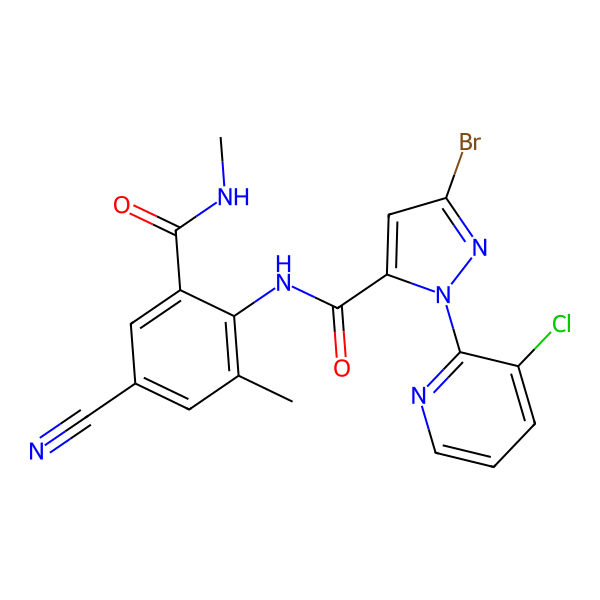
Cyantraniliprole is a carboxamide that is chlorantraniliprole in which the chlorine atom attached to the phenyl ring has been replaced by a cyano group. A ryanodine receptor agonist, it is used as insecticide for the control of whitefly, thrips, aphids, fruitflies, and fruit worms in crops such as onions, potatoes and tomatoes. It is highly toxic to honeybees. It has a role as a ryanodine receptor agonist. It is a secondary carboxamide, a nitrile, a pyrazole insecticide, a member of pyridines, an organochlorine compound and an organobromine compound.
Source: ChEBI
| Molecular formula | C19H14BrClN6O2 |
|---|---|
| Molecular weight | 473.7 g/mol |
| IUPAC name | 3-bromo-1-(3-chloro-2-pyridinyl)-N-[4-cyano-2-methyl-6-(methylcarbamoyl)phenyl]pyrazole-5-carboxamide |
| InChIKey | DVBUIBGJRQBEDP-UHFFFAOYSA-N |
| SMILES | CC1=CC(=CC(=C1NC(=O)C2=CC(=NN2C3=C(C=CC=N3)Cl)Br)C(=O)NC)C#N |
Computed by PubChem (NCBI)