Fluopimomide
cas: 1309859-39-9 — see every product listed under this CAS number, including other names
Fluopimomide (CAS 1309859-39-9) is a chemical reagent available from Chemat. Available pack sizes: on request, 10mg, 25mg, 50mg, 100mg, 200mg, 500mg, 1x25mg. Offered by: Chemat Brand, Hubei YoungXin, Dr. Ehrenstorfer, Biosynth.
| brand | Chemat Brand |
|---|---|
| catalog number | ULF185001 |
| cas | 1309859-39-9 |
| size | on request |
| availability | Do potwierdzenia przez Chemat|To be confirmed by Chemat |
Need more information?
Ask us about this product — we're happy to help.
Available pack sizes
| brand | size | price | |
|---|---|---|---|
| Chemat Brand | on request | price on request | |
| Hubei YoungXin | 10mg | price on request | |
| Hubei YoungXin | 25mg | price on request | |
| Hubei YoungXin | 50mg | price on request | |
| Hubei YoungXin | 100mg | price on request | |
| Hubei YoungXin | 200mg | price on request | |
| Dr. Ehrenstorfer | 10mg | price on request | |
| Biosynth | 500mg | price on request | |
| HPC Standards | 1x25mg | 1390.52 Pln |
properties
| purity | No data |
|---|---|
| category | Chemicals |
| delivery time | To be confirmed by Chemat |
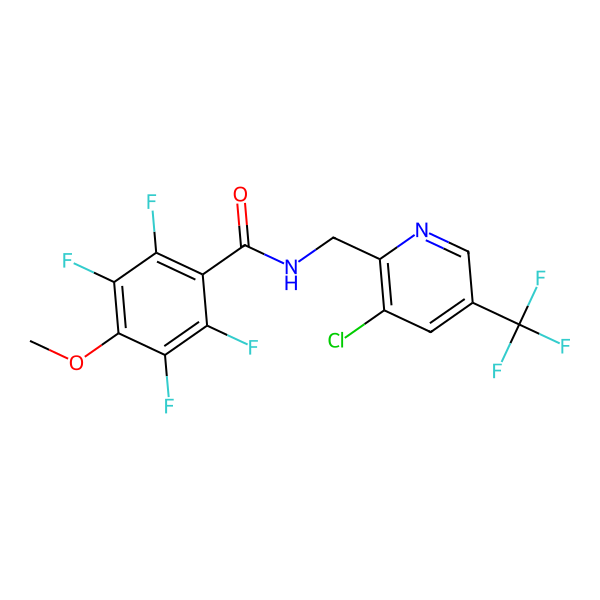
Fluopimomide is a benzamide resulting from the formal condensation of the carboxy group of 2,3,5,6-tetrafluoro-4-methoxybenzoic acid with the amino group of 1-[3-chloro-5-(trifluoromethyl)pyridin-2-yl]methanamine. It is a benzamide fungicide, synthesized by Shandong Sino-Agri United Biotechnology Co., Ltd (China). Used for the control of cucumber and grape downy mildew, phytophthora capsici, litchi downy blight, potato late blight, rice sheath blight, and cotton rhizoctonia solani. It has a role as an antifungal agrochemical. It is a member of benzamides, a monomethoxybenzene, an organofluorine compound, a monochloropyridine and a benzamide fungicide.
Source: ChEBI
| Molecular formula | C15H8ClF7N2O2 |
|---|---|
| Molecular weight | 416.68 g/mol |
| IUPAC name | N-[[3-chloro-5-(trifluoromethyl)-2-pyridinyl]methyl]-2,3,5,6-tetrafluoro-4-methoxybenzamide |
| InChIKey | DNJKFZQFTZJKDK-UHFFFAOYSA-N |
| SMILES | COC1=C(C(=C(C(=C1F)F)C(=O)NCC2=C(C=C(C=N2)C(F)(F)F)Cl)F)F |
Computed by PubChem (NCBI)