Naringin
cas: 10236-47-2 — see every product listed under this CAS number, including other names
Naringin (CAS 10236-47-2) is a chemical reagent available from Chemat. Available pack sizes: on request, 250mg, 100mg, 10g, 200mg, 10mM (in 1ml dmso), 500g, 1000g. Offered by: Chemat Brand, Dr. Ehrenstorfer, GLPBio, Biosynth.
| brand | Chemat Brand |
|---|---|
| catalog number | ULN079005 |
| cas | 10236-47-2 |
| size | on request |
| availability | Do potwierdzenia przez Chemat|To be confirmed by Chemat |
Need more information?
Ask us about this product — we're happy to help.
Available pack sizes
| brand | size | price | |
|---|---|---|---|
| Chemat Brand | on request | price on request | |
| Dr. Ehrenstorfer | 250mg | price on request | |
| GLPBio | 100mg | 517.47 Pln | |
| GLPBio | 10g | 643.84 Pln | |
| GLPBio | 200mg | 578.32 Pln | |
| GLPBio | 10mM (in 1ml dmso) | 597.04 Pln | |
| Biosynth | 500g | price on request | |
| Biosynth | 1000g | price on request | |
| Biosynth | 2000g | price on request | |
| Biosynth | 10000g | price on request | |
| Biosynth | 5000g | price on request | |
| Sigma-Aldrich | 500MG | 542.50 Pln | |
| HPC Standards | 1x250mg | 268.84 Pln |
properties
| purity | No data |
|---|---|
| category | Chemicals |
| delivery time | To be confirmed by Chemat |
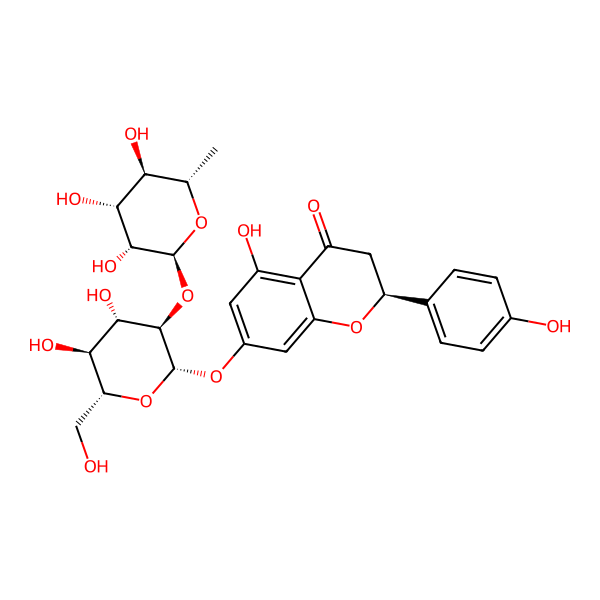
Naringin is a disaccharide derivative that is (S)-naringenin substituted by a 2-O-(alpha-L-rhamnopyranosyl)-beta-D-glucopyranosyl moiety at position 7 via a glycosidic linkage. It has a role as a metabolite, an antineoplastic agent and an anti-inflammatory agent. It is a member of 4'-hydroxyflavanones, a (2S)-flavan-4-one, a neohesperidoside, a dihydroxyflavanone and a disaccharide derivative. It is functionally related to a (S)-naringenin.
Source: ChEBI
| Molecular formula | C27H32O14 |
|---|---|
| Molecular weight | 580.5 g/mol |
| IUPAC name | (2S)-7-[(2S,3R,4S,5S,6R)-4,5-dihydroxy-6-(hydroxymethyl)-3-[(2S,3R,4R,5R,6S)-3,4,5-trihydroxy-6-methyloxan-2-yl]oxyoxan-2-yl]oxy-5-hydroxy-2-(4-hydroxyphenyl)-2,3-dihydrochromen-4-one |
| InChIKey | DFPMSGMNTNDNHN-ZPHOTFPESA-N |
| SMILES | C[C@H]1[C@@H]([C@H]([C@H]([C@@H](O1)O[C@@H]2[C@H]([C@@H]([C@H](O[C@H]2OC3=CC(=C4C(=O)C[C@H](OC4=C3)C5=CC=C(C=C5)O)O)CO)O)O)O)O)O |
Computed by PubChem (NCBI)
Synonyms:
naringin, aurantiin, Naringoside, Naringenin 7-O-neohesperidoside, Naringenin-7-beta-neohesperidoside, Naringenin 7-O-[alpha-L-rhamnosyl-(1->2)-beta-D-glucoside], 4',5,7-trihydroxyflavanone 7-rhamnoglucoside, Naringenin 7-O-(alpha-L-rhamnosyl-(1->2)-beta-D-glucoside), Citrus naringinine, Naringenin Glycoside