Pyflubumide
cas: 926914-55-8 — see every product listed under this CAS number, including other names
Pyflubumide (CAS 926914-55-8) is a chemical reagent available from Chemat. Available pack sizes: on request, 10mg, 50mg, 5mg, 25mg, 100mg, 1x10mg. Offered by: Chemat Brand, Dr. Ehrenstorfer, Biosynth, HPC Standards.
| brand | Chemat Brand |
|---|---|
| catalog number | ULP285001 |
| cas | 926914-55-8 |
| size | on request |
| availability | Do potwierdzenia przez Chemat|To be confirmed by Chemat |
Need more information?
Ask us about this product — we're happy to help.
Available pack sizes
| brand | size | price | |
|---|---|---|---|
| Chemat Brand | on request | price on request | |
| Dr. Ehrenstorfer | 10mg | price on request | |
| Biosynth | 50mg | price on request | |
| Biosynth | 5mg | price on request | |
| Biosynth | 10mg | price on request | |
| Biosynth | 25mg | price on request | |
| Biosynth | 100mg | price on request | |
| HPC Standards | 1x10mg | 1348.20 Pln |
properties
| purity | No data |
|---|---|
| category | Chemicals |
| delivery time | To be confirmed by Chemat |
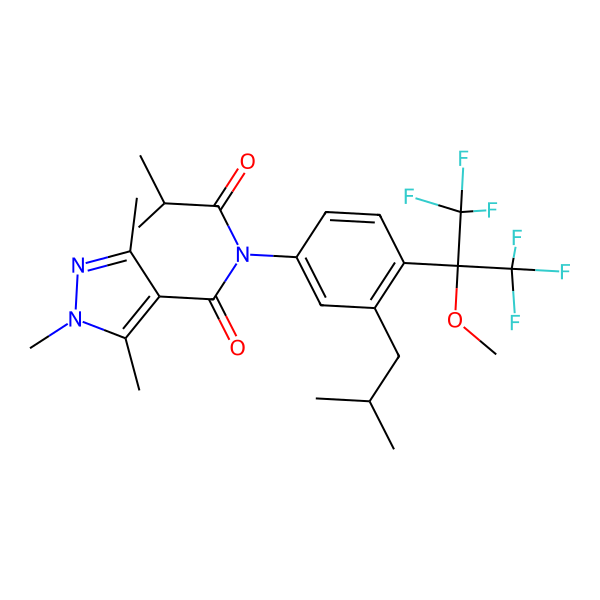
Pyflubumide is a dicarboximide resulting from the formal condensation of the amino group of 4-(1,1,1,3,3,3-hexafluoro-2-methoxypropan-2-yl)-3-isobutylaniline with isobutyric acid and with 1,3,5-trimethylpyrazole-4-carboxylic acid. Developed by Nihon Nohyaku Co. Ltd. (Japan), it is a pro-acaricide, with its metabolite (the -NH form lacking the isubutanoyl group) exhibiting high activity on mitochondrial complex II. It has been reported to be very effective in controlling spider mites (Tetranychus, Oligonychus, and Panonychus species) during all life stages. It is an ether, a member of pyrazoles, a dicarboximide and an organofluorine acaricide.
Source: ChEBI
| Molecular formula | C25H31F6N3O3 |
|---|---|
| Molecular weight | 535.5 g/mol |
| IUPAC name | N-[4-(1,1,1,3,3,3-hexafluoro-2-methoxypropan-2-yl)-3-(2-methylpropyl)phenyl]-1,3,5-trimethyl-N-(2-methylpropanoyl)pyrazole-4-carboxamide |
| InChIKey | DZVWKNFPXMUIFA-UHFFFAOYSA-N |
| SMILES | CC1=C(C(=NN1C)C)C(=O)N(C2=CC(=C(C=C2)C(C(F)(F)F)(C(F)(F)F)OC)CC(C)C)C(=O)C(C)C |
Computed by PubChem (NCBI)