Trandolapril
cas: 87679-37-6 — see every product listed under this CAS number, including other names
Trandolapril (CAS 87679-37-6) is a chemical reagent available from Chemat. Available pack sizes: on request, 250mg, 10mg, 100mg, 10mM (in 1ml dmso), 50mg, 1x10mg. Offered by: Chemat Brand, Mikromol, LoGiCal, GLPBio.
| brand | Chemat Brand |
|---|---|
| catalog number | ULT071 |
| cas | 87679-37-6 |
| size | on request |
| availability | Do potwierdzenia przez Chemat|To be confirmed by Chemat |
Need more information?
Ask us about this product — we're happy to help.
Available pack sizes
| brand | size | price | |
|---|---|---|---|
| Chemat Brand | on request | price on request | |
| Mikromol | 250mg | price on request | |
| LoGiCal | 10mg | price on request | |
| GLPBio | 10mg | 737.45 Pln | |
| GLPBio | 100mg | 2015.23 Pln | |
| GLPBio | 10mM (in 1ml dmso) | 657.89 Pln | |
| GLPBio | 50mg | 1425.49 Pln | |
| Biosynth | 250mg | price on request | |
| Biosynth | 100mg | price on request | |
| HPC Standards | 1x10mg | price on request |
properties
| purity | No data |
|---|---|
| category | Chemicals |
| delivery time | To be confirmed by Chemat |
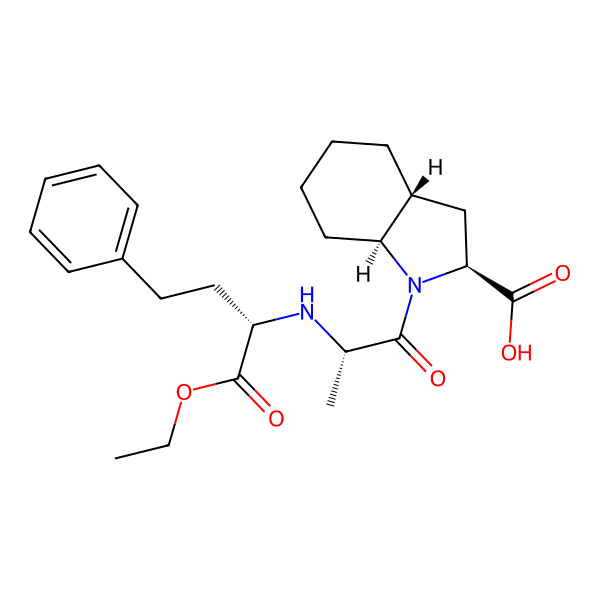
Trandolapril is a heterobicylic compound that is (2S,3aR,7aS)-1-[(2S)-2-aminopropanoyl]octahydro-1H-indole-2-carboxylic acid in which the hydrogen of the amino group is substituted by a (2R)-1-ethoxy-1-oxo-4-phenylbutan-2-yl group. It is a angiotensin-converting enzyme inhibitor and a prodrug used for the treatment of hypertension. It has a role as an EC 3.4.15.1 (peptidyl-dipeptidase A) inhibitor, an antihypertensive agent and a prodrug. It is a tertiary carboxamide, an ethyl ester, an organic heterobicyclic compound, a dicarboxylic acid monoester, a dipeptide and a secondary amino compound. It is functionally related to a trandolaprilat.
Source: ChEBI
| Molecular formula | C24H34N2O5 |
|---|---|
| Molecular weight | 430.5 g/mol |
| IUPAC name | (2S,3aR,7aS)-1-[(2S)-2-[[(2S)-1-ethoxy-1-oxo-4-phenylbutan-2-yl]amino]propanoyl]-2,3,3a,4,5,6,7,7a-octahydroindole-2-carboxylic acid |
| InChIKey | VXFJYXUZANRPDJ-WTNASJBWSA-N |
| SMILES | CCOC(=O)[C@H](CCC1=CC=CC=C1)N[C@@H](C)C(=O)N2[C@H]3CCCC[C@@H]3C[C@H]2C(=O)O |
Computed by PubChem (NCBI)