Verbascoside
cas: 61276-17-3 — see every product listed under this CAS number, including other names
Verbascoside (CAS 61276-17-3) is a chemical reagent available from Chemat. Available pack sizes: on request, 10mg, 100mg, 1g, 50mg, 25mg, 250mg, 1x10mg. Offered by: Chemat Brand, GLPBio, Biosynth, Sigma-Aldrich.
| brand | Chemat Brand |
|---|---|
| catalog number | AO-V0031.00 |
| cas | 61276-17-3 |
| size | on request |
| availability | In stock |
Need more information?
Ask us about this product — we're happy to help.
Available pack sizes
| brand | size | price | |
|---|---|---|---|
| Chemat Brand | on request | price on request | |
| GLPBio | 10mg | 685.97 Pln | |
| GLPBio | 100mg | 2005.87 Pln | |
| GLPBio | 1g | 43264.48 Pln | |
| GLPBio | 50mg | 1313.16 Pln | |
| Biosynth | 25mg | price on request | |
| Biosynth | 10mg | price on request | |
| Biosynth | 50mg | price on request | |
| Biosynth | 100mg | price on request | |
| Biosynth | 250mg | price on request | |
| Sigma-Aldrich | 10MG | 2231.00 Pln | |
| HPC Standards | 1x10mg | price on request |
properties
| delivery time | To be confirmed by Chemat |
|---|---|
| purity | No data |
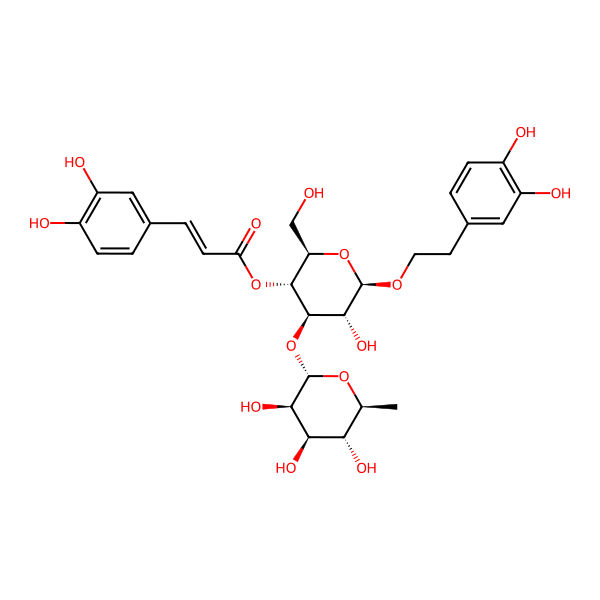
Acteoside is a glycoside that is the alpha-L-rhamnosyl-(13)-beta-D-glucoside of hydroxytyrosol in which the hydroxy group at position 4 of the glucopyranosyl moiety has undergone esterification by formal condensation with trans-caffeic acid. It has a role as an antibacterial agent, a neuroprotective agent, an anti-inflammatory agent, an antileishmanial agent and a plant metabolite. It is a glycoside, a polyphenol, a member of catechols, a cinnamate ester and a disaccharide derivative. It is functionally related to a trans-caffeic acid and a hydroxytyrosol.
Source: ChEBI
| Molecular formula | C29H36O15 |
|---|---|
| Molecular weight | 624.6 g/mol |
| IUPAC name | [(2R,3R,4R,5R,6R)-6-[2-(3,4-dihydroxyphenyl)ethoxy]-5-hydroxy-2-(hydroxymethyl)-4-[(2S,3R,4R,5R,6S)-3,4,5-trihydroxy-6-methyloxan-2-yl]oxyoxan-3-yl] (E)-3-(3,4-dihydroxyphenyl)prop-2-enoate |
| InChIKey | FBSKJMQYURKNSU-ZLSOWSIRSA-N |
| SMILES | C[C@H]1[C@@H]([C@H]([C@H]([C@@H](O1)O[C@@H]2[C@H]([C@@H](O[C@@H]([C@H]2OC(=O)/C=C/C3=CC(=C(C=C3)O)O)CO)OCCC4=CC(=C(C=C4)O)O)O)O)O)O |
Computed by PubChem (NCBI)
Synonyms:
Verbascoside, Acteoside, Kusaginin, Verbacoside, acetoside, cid_24978601, Reh-acteoside, Verb, RUSSETINOL, STEREOSPERMIN