Vorapaxar
cas: 618385-01-6 — see every product listed under this CAS number, including other names
Vorapaxar (CAS 618385-01-6) is a chemical reagent available from Chemat. Available pack sizes: 10mg, 25mg, 5mg, 10mM (in 1ml dmso), 50mg, 100mg. Offered by: GLPBio, Biosynth, Sigma-Aldrich.
| brand | GLPBio |
|---|---|
| catalog number | GC17545-10 |
| cas | 618385-01-6 |
| size | 10mg |
Need more information?
Ask us about this product — we're happy to help.
Available pack sizes
| brand | size | price | |
|---|---|---|---|
| GLPBio | 10mg | 1453.57 Pln | |
| GLPBio | 25mg | 2586.25 Pln | |
| GLPBio | 5mg | 980.84 Pln | |
| GLPBio | 10mM (in 1ml dmso) | 1107.21 Pln | |
| GLPBio | 50mg | 3236.84 Pln | |
| Biosynth | 10mg | price on request | |
| Biosynth | 5mg | price on request | |
| Biosynth | 25mg | price on request | |
| Biosynth | 100mg | price on request | |
| Biosynth | 50mg | price on request | |
| Sigma-Aldrich | 25MG | 1860.00 Pln | |
| Sigma-Aldrich | 5MG | 500.00 Pln |
properties
| purity | No data |
|---|---|
| delivery time | To be confirmed by Chemat |
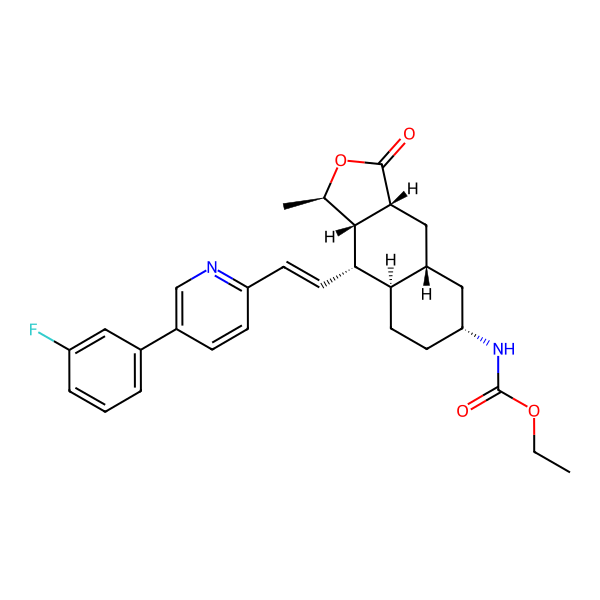
Vorapaxar is a carbamate ester that is the ethyl ester of [(1R,3aR,4aR,6R,8aR,9S,9aS)-9-{(E)-2-[5-(3-fluorophenyl)pyridin-2-yl]ethynyl}-1-methyl-3-oxododecahydronaphtho[2,3-c]furan-6-yl]carbamic acid. A protease-activated receptor-1 antagonist used (as its sulfate salt) for the reduction of thrombotic cardiovascular events in patients with a history of myocardial infarction (MI) or with peripheral arterial disease. It has been shown to reduce the rate of a combined endpoint of cardiovascular death, MI, stroke and urgent coronary revascularisation. It has a role as a cardiovascular drug, a platelet aggregation inhibitor and a protease-activated receptor-1 antagonist. It is a carbamate ester, a lactone, a member of pyridines, an organofluorine compound and a naphthofuran. It is a conjugate base of a vorapaxar(1+).
Source: ChEBI
| Molecular formula | C29H33FN2O4 |
|---|---|
| Molecular weight | 492.6 g/mol |
| IUPAC name | ethyl N-[(1R,3aR,4aR,6R,8aR,9S,9aS)-9-[(E)-2-[5-(3-fluorophenyl)-2-pyridinyl]ethenyl]-1-methyl-3-oxo-3a,4,4a,5,6,7,8,8a,9,9a-decahydro-1H-benzo[f][2]benzofuran-6-yl]carbamate |
| InChIKey | ZBGXUVOIWDMMJE-QHNZEKIYSA-N |
| SMILES | CCOC(=O)N[C@@H]1CC[C@@H]2[C@@H](C1)C[C@@H]3[C@H]([C@H]2/C=C/C4=NC=C(C=C4)C5=CC(=CC=C5)F)[C@H](OC3=O)C |
Computed by PubChem (NCBI)