Boscalid
cas: 188425-85-6 — see every product listed under this CAS number, including other names
Boscalid (CAS 188425-85-6) is a chemical reagent available from Chemat. Available pack sizes: on request, 10g, 1g, 100mg, 200mg, 500mg, 50mg, 50g. Offered by: Chemat Brand, TRC, Dr. Ehrenstorfer, TargetMol.
| brand | Chemat Brand |
|---|---|
| catalog number | ULB133001 |
| cas | 188425-85-6 |
| size | on request |
| availability | Do potwierdzenia przez Chemat|To be confirmed by Chemat |
Need more information?
Ask us about this product — we're happy to help.
Available pack sizes
| brand | size | price | |
|---|---|---|---|
| Chemat Brand | on request | price on request | |
| TRC | 10g | price on request | |
| TRC | 1g | price on request | |
| Dr. Ehrenstorfer | 100mg | price on request | |
| TargetMol | 1g | 937.32 Pln | |
| TargetMol | 100mg | 419.13 Pln | |
| TargetMol | 200mg | 499.07 Pln | |
| TargetMol | 500mg | 691.36 Pln | |
| GLPBio | 100mg | 620.44 Pln | |
| GLPBio | 50mg | 564.28 Pln | |
| Biosynth | 50g | price on request | |
| Sigma-Aldrich | 50MG | 617.00 Pln |
properties
| purity | No data |
|---|---|
| category | Chemicals |
| delivery time | To be confirmed by Chemat |
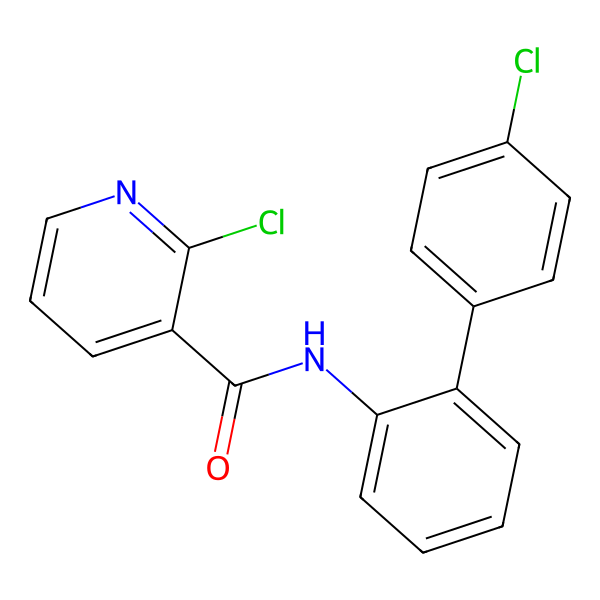
Boscalid is a pyridinecarboxamide obtained by formal condensation of the carboxy group of 2-chloronicotinic acid with the amino group of 4'-chlorobiphenyl-2-amine. A fungicide active against a broad range of fungal pathogens including Botrytis spp., Alternaria spp. and Sclerotinia spp. for use on a wide range of crops including fruit, vegetables and ornamentals. It has a role as a xenobiotic, an environmental contaminant, an EC 1.3.5.1 [succinate dehydrogenase (quinone)] inhibitor and an antifungal agrochemical. It is a member of biphenyls, a pyridinecarboxamide, a member of monochlorobenzenes and an anilide fungicide. It is functionally related to a nicotinic acid.
Source: ChEBI
| Molecular formula | C18H12Cl2N2O |
|---|---|
| Molecular weight | 343.2 g/mol |
| IUPAC name | 2-chloro-N-[2-(4-chlorophenyl)phenyl]pyridine-3-carboxamide |
| InChIKey | WYEMLYFITZORAB-UHFFFAOYSA-N |
| SMILES | C1=CC=C(C(=C1)C2=CC=C(C=C2)Cl)NC(=O)C3=C(N=CC=C3)Cl |
Computed by PubChem (NCBI)