Products 106-60-5
CAS 106-60-5 appears in our catalog under these names: 5-Aminolevulinic acid, 99.92%, 5–Amino–4–oxopentanoic acid, 5-amino-4-oxopentanoic acid, 98%. Offered by: MedChemExpress, GLPBio, Chemat. Available pack sizes: 10mM/1mL, 10 mg, 25 mg, 50 mg, 100 mg, 100mg, 1g, 10g.
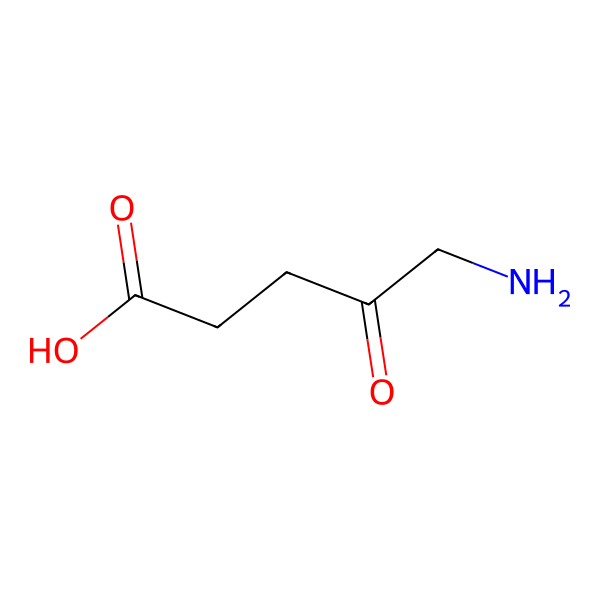
5-aminolevulinic acid is the simplest delta-amino acid in which the hydrogens at the gamma position are replaced by an oxo group. It is metabolised to protoporphyrin IX, a photoactive compound which accumulates in the skin. Used (in the form of the hydrochloride salt)in combination with blue light illumination for the treatment of minimally to moderately thick actinic keratosis of the face or scalp. It has a role as an antineoplastic agent, a photosensitizing agent, a dermatologic drug, a prodrug, a mouse metabolite, a Saccharomyces cerevisiae metabolite, a plant metabolite, an Escherichia coli metabolite and a human metabolite. It is a delta-amino acid and a 4-oxo monocarboxylic acid. It is functionally related to a 4-oxopentanoic acid. It is a conjugate base of a 5-ammoniolevulinic acid. It is a conjugate acid of a 5-aminolevulinate. It is a tautomer of a 5-ammoniolevulinate.
Source: ChEBI
| Molecular formula | C5H9NO3 |
|---|---|
| Molecular weight | 131.13 g/mol |
| IUPAC name | 5-amino-4-oxopentanoic acid |
| InChIKey | ZGXJTSGNIOSYLO-UHFFFAOYSA-N |
| SMILES | C(CC(=O)O)C(=O)CN |
Computed by PubChem (NCBI)