Products 120124-51-8
CAS 120124-51-8 is the registry number for Chrysobactin. Offered by: MedChemExpress. Available pack sizes: Get quote.
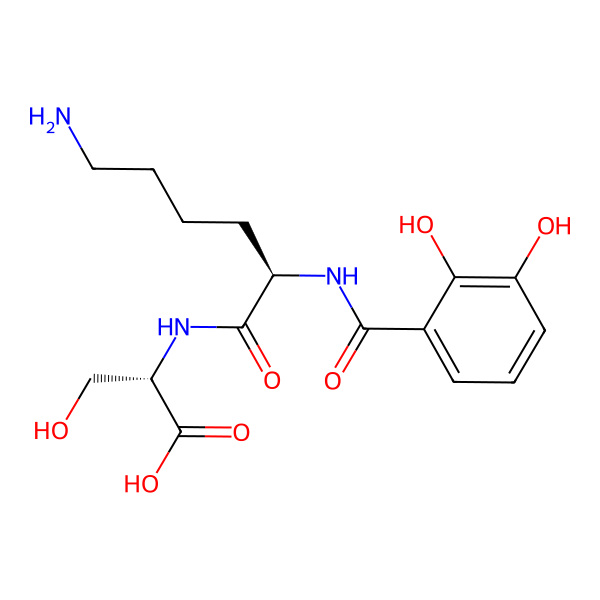
Chrysobactin is a catechol-type siderophore with a structure of D-lysyl-L-serine substituted on N2 of the lysyl residue by a 2,3-dihydroxybenzoyl group. It is produced by the Gram-negative bacillus Dickeya dadantii (previously known as Erwinia chrysanthem). Only the catecholate hydroxyl groups participate in metal coordination, so chrysobactin cannot provide full 1:1 coordination of Fe(III); at neutral pH and concentrations of about 0.1 mM, ferric chrysobactin exists as a mixture of bis and tris complexes. It has a role as a siderophore and a bacterial metabolite. It is a primary alcohol, a monocarboxylic acid, a member of catechols, a dipeptide and a primary amino compound.
Source: ChEBI
| Molecular formula | C16H23N3O7 |
|---|---|
| Molecular weight | 369.37 g/mol |
| IUPAC name | (2S)-2-[[(2R)-6-amino-2-[(2,3-dihydroxybenzoyl)amino]hexanoyl]amino]-3-hydroxypropanoic acid |
| InChIKey | NNTXFOAPABMVEG-MNOVXSKESA-N |
| SMILES | C1=CC(=C(C(=C1)O)O)C(=O)N[C@H](CCCCN)C(=O)N[C@@H](CO)C(=O)O |
Computed by PubChem (NCBI)
Synonyms:
Chrysobactin, N-(N(2)-(2,3-Dihydroxybenzoyl)lysyl)serine, N(2)-(2,3-dihydroxybenzoyl)-D-lysyl-L-serine, L-Serine, N-(N2-(2,3-dihydroxybenzoyl)-D-lysyl)-, N2-(2,3-Dihydroxybenzoyl)-D-lysyl-L-serine, 2-(2,3-dihydroxybenzoyl)-D-lysyl-L-serine, orb1697815, N~2~-(2,3-Dihydroxybenzoyl)-D-lysyl-L-serine