Products 21967-41-9
CAS 21967-41-9 appears in our catalog under these names: Baicalin, >95% (HPLC), Baicalin, Baicalin/ 98.96% (existing batch purity), Baicalin 7-b-D-glucuronide, Baicalin, >90.0%(T). Offered by: TRC, Dr. Ehrenstorfer, GLPBio, TargetMol, Biosynth. Available pack sizes: 10mg, 1g, 25mg, 100mg, 20mg, 10mM (in 1ml dmso), 50mg, 500mg.
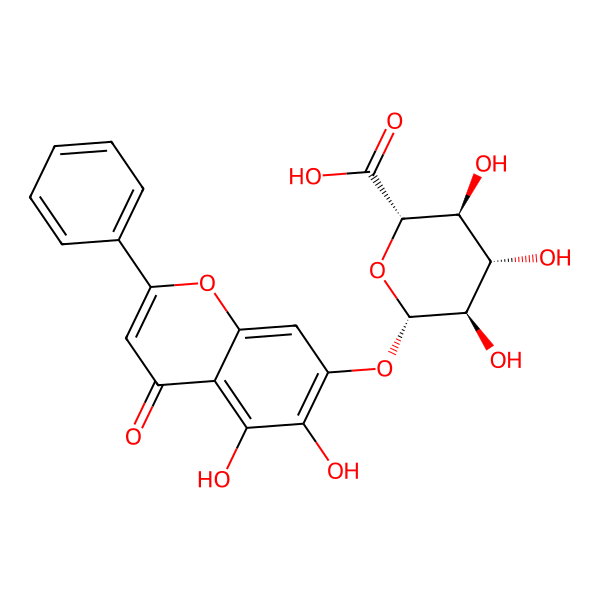
Baicalin is the glycosyloxyflavone which is the 7-O-glucuronide of baicalein. It is an active ingredient of Chinese herbal medicine Scutellaria baicalensis. It has a role as an antiatherosclerotic agent, an anticoronaviral agent, an EC 2.7.7.48 (RNA-directed RNA polymerase) inhibitor, a ferroptosis inhibitor, an antioxidant, an antibacterial agent, a non-steroidal anti-inflammatory drug, an antineoplastic agent, a prodrug, a neuroprotective agent, an EC 3.4.21.26 (prolyl oligopeptidase) inhibitor, a plant metabolite and a cardioprotective agent. It is a glucosiduronic acid, a dihydroxyflavone, a glycosyloxyflavone and a monosaccharide derivative. It is functionally related to a baicalein. It is a conjugate acid of a baicalin(1-).
Source: ChEBI
| Molecular formula | C21H18O11 |
|---|---|
| Molecular weight | 446.4 g/mol |
| IUPAC name | (2S,3S,4S,5R,6S)-6-(5,6-dihydroxy-4-oxo-2-phenylchromen-7-yl)oxy-3,4,5-trihydroxyoxane-2-carboxylic acid |
| InChIKey | IKIIZLYTISPENI-ZFORQUDYSA-N |
| SMILES | C1=CC=C(C=C1)C2=CC(=O)C3=C(C(=C(C=C3O2)O[C@H]4[C@@H]([C@H]([C@@H]([C@H](O4)C(=O)O)O)O)O)O)O |
Computed by PubChem (NCBI)
Synonyms:
Baicalin, Baicalein 7-O-glucuronide, Baicalein 7-glucuronide, 7-D-Glucuronic acid-5,6-dihydroxyflavone, 5,6-dihydroxy-4-oxo-2-phenyl-4H-chromen-7-yl beta-D-glucopyranosiduronic acid, 7-D-glucuronic acid-5,6-dihydroxy-flavone, 5,6,7-trihydroxyflavone-7-O-beta-D-glucuronate, Baicalein 7-O-.beta.-D-glucuronide, Baicalin 1000 microg/mL in Methanol, 5,6,7-trihydroxyflavone 7-O-beta-D-glucuronide