Bezafibrate
cas: 41859-67-0 — see every product listed under this CAS number, including other names
Bezafibrate (CAS 41859-67-0) is a chemical reagent available from Chemat. Available pack sizes: on request, 500mg, 10mg, 100mg, 10mM (in 1ml dmso), 50mg, 25g, 50g. Offered by: Chemat Brand, Mikromol, LoGiCal, Dr. Ehrenstorfer.
| brand | Chemat Brand |
|---|---|
| catalog number | ULB076001 |
| cas | 41859-67-0 |
| size | on request |
| availability | Do potwierdzenia przez Chemat|To be confirmed by Chemat |
Need more information?
Ask us about this product — we're happy to help.
Available pack sizes
| brand | size | price | |
|---|---|---|---|
| Chemat Brand | on request | price on request | |
| Mikromol | 500mg | price on request | |
| LoGiCal | 10mg | price on request | |
| Dr. Ehrenstorfer | 100mg | price on request | |
| GLPBio | 10mM (in 1ml dmso) | 583.00 Pln | |
| GLPBio | 50mg | 629.80 Pln | |
| Biosynth | 25g | price on request | |
| Biosynth | 50g | price on request | |
| Biosynth | 100g | price on request | |
| Sigma-Aldrich | 1EA | 665.70 Pln | |
| Sigma-Aldrich | 1G | 205.00 Pln | |
| Sigma-Aldrich | 25G | 1980.00 Pln | |
| Sigma-Aldrich | 5G | 596.00 Pln | |
| HPC Standards | 1x100mg | 285.76 Pln |
properties
| purity | No data |
|---|---|
| category | Chemicals |
| delivery time | To be confirmed by Chemat |
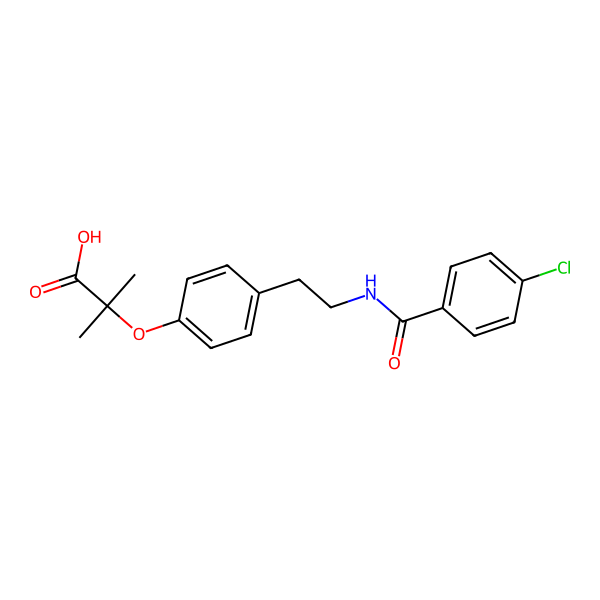
Bezafibrate is a monocarboxylic acid amide obtained by the formal condensation of the carboxy group of 4-chlorobenzoic acid with the amino group of 2-[4-(2-aminoethyl)phenoxy]-2-methylpropanoic acid. Benafibrate is used for the treatment of hyperlipidaemia. It has a role as a geroprotector, an antilipemic drug, a xenobiotic and an environmental contaminant. It is a monocarboxylic acid, a monocarboxylic acid amide, an aromatic ether and a member of monochlorobenzenes. It is functionally related to a propionic acid.
Source: ChEBI
| Molecular formula | C19H20ClNO4 |
|---|---|
| Molecular weight | 361.8 g/mol |
| IUPAC name | 2-[4-[2-[(4-chlorobenzoyl)amino]ethyl]phenoxy]-2-methylpropanoic acid |
| InChIKey | IIBYAHWJQTYFKB-UHFFFAOYSA-N |
| SMILES | CC(C)(C(=O)O)OC1=CC=C(C=C1)CCNC(=O)C2=CC=C(C=C2)Cl |
Computed by PubChem (NCBI)