Rimonabant
cas: 168273-06-1 — see every product listed under this CAS number, including other names
Rimonabant (CAS 168273-06-1) is a chemical reagent available from Chemat. Available pack sizes: 100mg, 1g, 25mg, 10mM (in 1ml dmso), 0,25g, 0,1g, 0,5g, 2g. Offered by: GLPBio, Biosynth.
| brand | GLPBio |
|---|---|
| catalog number | GC17259-100 |
| cas | 168273-06-1 |
| size | 100mg |
Need more information?
Ask us about this product — we're happy to help.
Available pack sizes
| brand | size | price | |
|---|---|---|---|
| GLPBio | 100mg | 1289.75 Pln | |
| GLPBio | 1g | 5305.62 Pln | |
| GLPBio | 25mg | 728.09 Pln | |
| GLPBio | 10mM (in 1ml dmso) | 587.68 Pln | |
| Biosynth | 0,25g | price on request | |
| Biosynth | 0,1g | price on request | |
| Biosynth | 0,5g | price on request | |
| Biosynth | 1g | price on request | |
| Biosynth | 2g | price on request |
properties
| purity | No data |
|---|---|
| delivery time | To be confirmed by Chemat |
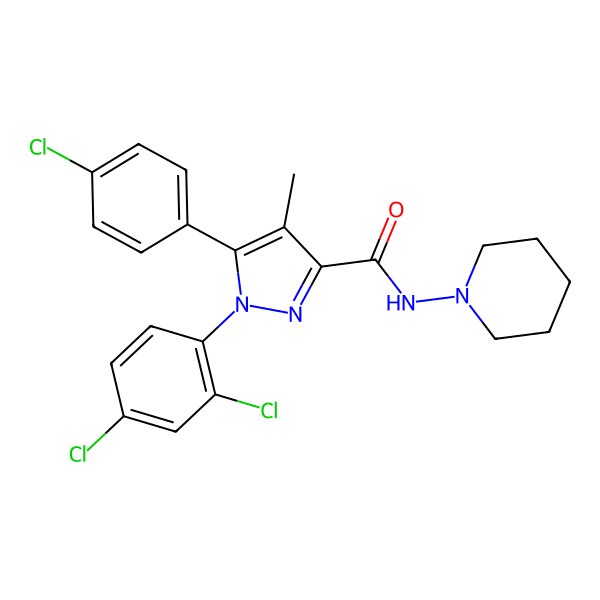
Rimonabant is a carbohydrazide obtained by formal condensation of the carboxy group of 5-(4-chlorophenyl)-1-(2,4-dichlorophenyl)-4-methyl-1H-pyrazole-3-carboxylic acid with the amino group of 1-aminopiperidine. It is a potent and selective cannabinoid receptor 1 (CB1R) antagonist. Besides its antagonistic properties, numerous studies have shown that, at micromolar concentrations rimonabant behaves as an inverse agonist at CB1 receptors. The drug was the first selective CB1 antagonist/inverse agonist introduced into clinical practice to treat obesity and metabolic-related disorders. It was later withdrawn from market due to CNS-related adverse effects including depression and suicidal ideation. It has a role as an appetite depressant, a CB1 receptor antagonist and an anti-obesity agent. It is a dichlorobenzene, a member of pyrazoles, a carbohydrazide, an amidopiperidine and a member of monochlorobenzenes.
Source: ChEBI
| Molecular formula | C22H21Cl3N4O |
|---|---|
| Molecular weight | 463.8 g/mol |
| IUPAC name | 5-(4-chlorophenyl)-1-(2,4-dichlorophenyl)-4-methyl-N-piperidin-1-ylpyrazole-3-carboxamide |
| InChIKey | JZCPYUJPEARBJL-UHFFFAOYSA-N |
| SMILES | CC1=C(N(N=C1C(=O)NN2CCCCC2)C3=C(C=C(C=C3)Cl)Cl)C4=CC=C(C=C4)Cl |
Computed by PubChem (NCBI)