Curcumin, 98%
cas: 458-37-7 — see every product listed under this CAS number, including other names
Curcumin, 98% (CAS 458-37-7) is a chemical reagent available from Chemat. Available pack sizes: 100g, 500g, 1kg, 5g, 25g, 1mg, 25mg, 100mg. Offered by: Combi-blocks, Ambeed.
| brand | Combi-blocks |
|---|---|
| catalog number | QE-8422-100g |
| cas | 458-37-7 |
| size | 100g |
Documents:
Safety Data Sheet (MSDS)
Need more information?
Ask us about this product — we're happy to help.
Available pack sizes
| brand | size | price | |
|---|---|---|---|
| Combi-blocks | 100g | price on request | |
| Combi-blocks | 500g | price on request | |
| Combi-blocks | 1kg | price on request | |
| Combi-blocks | 5g | price on request | |
| Combi-blocks | 25g | price on request | |
| Ambeed | 1mg | 125.62 Pln | |
| Ambeed | 25mg | 136.75 Pln | |
| Ambeed | 100mg | 153.44 Pln | |
| Ambeed | 10g | 175.69 Pln | |
| Ambeed | 25g | 197.94 Pln | |
| Ambeed | 100g | 225.75 Pln | |
| Ambeed | 500g | 637.38 Pln | |
| Ambeed | 1kg | 1199.19 Pln |
properties
| purity | 98% |
|---|---|
| delivery time | 1-2 weeks (only if in stock, to check click on availability) |
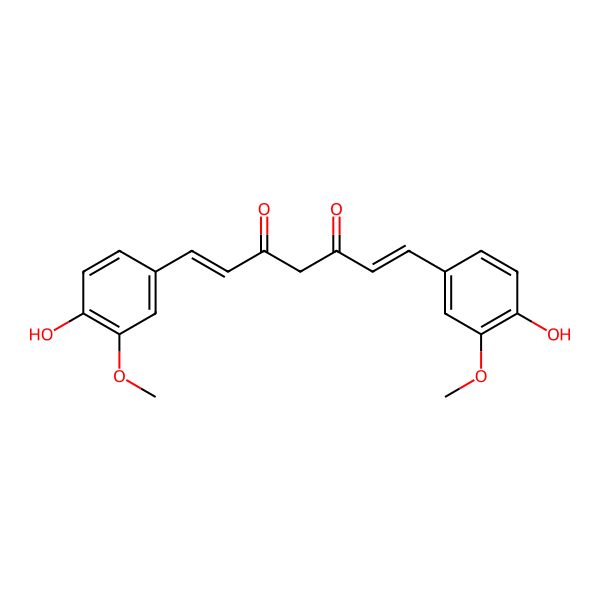
Curcumin is a beta-diketone that is methane in which two of the hydrogens are substituted by feruloyl groups. A natural dyestuff found in the root of Curcuma longa. It has a role as a geroprotector, a metabolite, a biological pigment, an antineoplastic agent, a flavouring agent, an antifungal agent, a lipoxygenase inhibitor, a dye, an iron chelator, an EC 1.1.1.21 (aldehyde reductase) inhibitor, a radical scavenger, a contraceptive drug, an EC 1.6.5.2 [NAD(P)H dehydrogenase (quinone)] inhibitor, a nutraceutical, an immunomodulator, a ligand, an EC 1.1.1.205 (IMP dehydrogenase) inhibitor, an EC 3.5.1.98 (histone deacetylase) inhibitor, a hepatoprotective agent, a neuroprotective agent, an EC 1.8.1.9 (thioredoxin reductase) inhibitor, an anti-inflammatory agent, an EC 2.7.10.2 (non-specific protein-tyrosine kinase) inhibitor, a food colouring and an EC 1.1.1.25 (shikimate dehydrogenase) inhibitor. It is a polyphenol, an aromatic ether, an enone, a beta-diketone and a diarylheptanoid. It is functionally related to a trans-ferulic acid.
Source: ChEBI
| Molecular formula | C21H20O6 |
|---|---|
| Molecular weight | 368.4 g/mol |
| IUPAC name | (1E,6E)-1,7-bis(4-hydroxy-3-methoxyphenyl)hepta-1,6-diene-3,5-dione |
| InChIKey | VFLDPWHFBUODDF-FCXRPNKRSA-N |
| SMILES | COC1=C(C=CC(=C1)/C=C/C(=O)CC(=O)/C=C/C2=CC(=C(C=C2)O)OC)O |
Computed by PubChem (NCBI)
Synonyms:
curcumin, Diferuloylmethane, Natural yellow 3, Kacha haldi, Curcumin I, Curcuma, Haldar, Indian saffron, Gelbwurz, Yellow Ginger