Eltrombopag
cas: 496775-61-2 — see every product listed under this CAS number, including other names
Eltrombopag (CAS 496775-61-2) is a chemical reagent available from Chemat. Available pack sizes: on request, 10mg, 100mg, 200mg, 25mg, 10mM (in 1ml dmso), 50mg, 500mg. Offered by: Chemat Brand, GLPBio, Biosynth.
| brand | Chemat Brand |
|---|---|
| catalog number | ULE481 |
| cas | 496775-61-2 |
| size | on request |
| availability | Do potwierdzenia przez Chemat|To be confirmed by Chemat |
Need more information?
Ask us about this product — we're happy to help.
Available pack sizes
| brand | size | price | |
|---|---|---|---|
| Chemat Brand | on request | price on request | |
| GLPBio | 10mg | 667.25 Pln | |
| GLPBio | 100mg | 1191.46 Pln | |
| GLPBio | 200mg | 1495.70 Pln | |
| GLPBio | 25mg | 826.38 Pln | |
| GLPBio | 10mM (in 1ml dmso) | 774.90 Pln | |
| GLPBio | 50mg | 1065.09 Pln | |
| GLPBio | 500mg | 1893.54 Pln | |
| Biosynth | 1g | price on request | |
| Biosynth | 0,5g | price on request | |
| Biosynth | 2g | price on request | |
| Biosynth | 5g | price on request | |
| Biosynth | 10g | price on request |
properties
| purity | No data |
|---|---|
| category | Chemicals |
| delivery time | To be confirmed by Chemat |
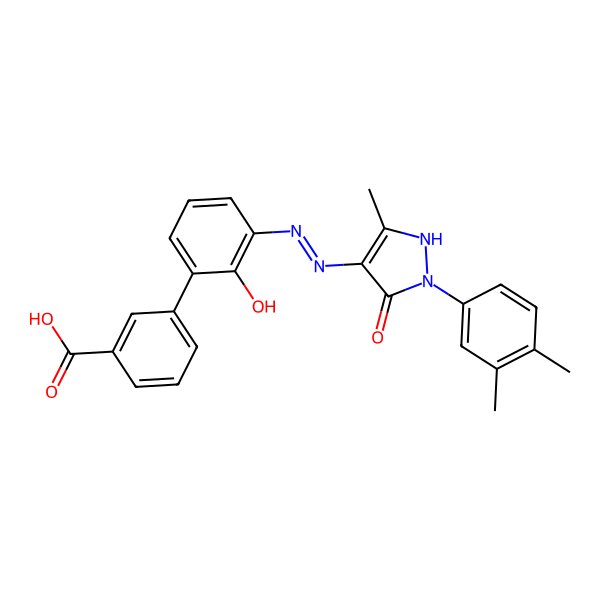
Eltrombopag is a hydrazine in which each nitrogen atom is substituted, one by a 3'-carboxy-2-hydroxy[1,1'-biphenyl]-3-yl group and the other by a 1-(3,4-dimethylphenyl)-3-methyl-5-oxo-1,5-dihydro-4H-pyrazol-4-ylidene group. A small molecule agonist of the c-mpl (TpoR) receptor (the physiological target of the hormone thrombopoietin), it has been developed as a medication for conditions that lead to thrombocytopenia (abnormally low platelet counts). It has a role as a xenobiotic and a thrombopoietin receptor agonist. It is a member of benzoic acids, a member of hydrazines and a member of pyrazoles.
Source: ChEBI
| Molecular formula | C25H22N4O4 |
|---|---|
| Molecular weight | 442.5 g/mol |
| IUPAC name | 3-[3-[[2-(3,4-dimethylphenyl)-5-methyl-3-oxo-1H-pyrazol-4-yl]diazenyl]-2-hydroxyphenyl]benzoic acid |
| InChIKey | SVOQIEJWJCQGDQ-UHFFFAOYSA-N |
| SMILES | CC1=C(C=C(C=C1)N2C(=O)C(=C(N2)C)N=NC3=CC=CC(=C3O)C4=CC(=CC=C4)C(=O)O)C |
Computed by PubChem (NCBI)