Iprodione
cas: 36734-19-7 — see every product listed under this CAS number, including other names
Iprodione (CAS 36734-19-7) is a chemical reagent available from Chemat. Available pack sizes: on request, 100mg, 10mM (in 1ml dmso), 250mg, 0,5g, 1g, 2g, 10g. Offered by: Chemat Brand, Dr. Ehrenstorfer, GLPBio, Biosynth.
| brand | Chemat Brand |
|---|---|
| catalog number | ULI062 |
| cas | 36734-19-7 |
| size | on request |
| availability | Do potwierdzenia przez Chemat|To be confirmed by Chemat |
Need more information?
Ask us about this product — we're happy to help.
Available pack sizes
| brand | size | price | |
|---|---|---|---|
| Chemat Brand | on request | price on request | |
| Dr. Ehrenstorfer | 100mg | price on request | |
| GLPBio | 10mM (in 1ml dmso) | 657.89 Pln | |
| GLPBio | 250mg | 629.80 Pln | |
| Biosynth | 0,5g | price on request | |
| Biosynth | 1g | price on request | |
| Biosynth | 2g | price on request | |
| Biosynth | 10g | price on request | |
| Biosynth | 5g | price on request | |
| Sigma-Aldrich | 50MG | 1090.00 Pln | |
| HPC Standards | 1x50mg | 328.07 Pln | |
| HPC Standards | 1x100mg | 328.07 Pln |
properties
| purity | No data |
|---|---|
| category | Chemicals |
| delivery time | To be confirmed by Chemat |
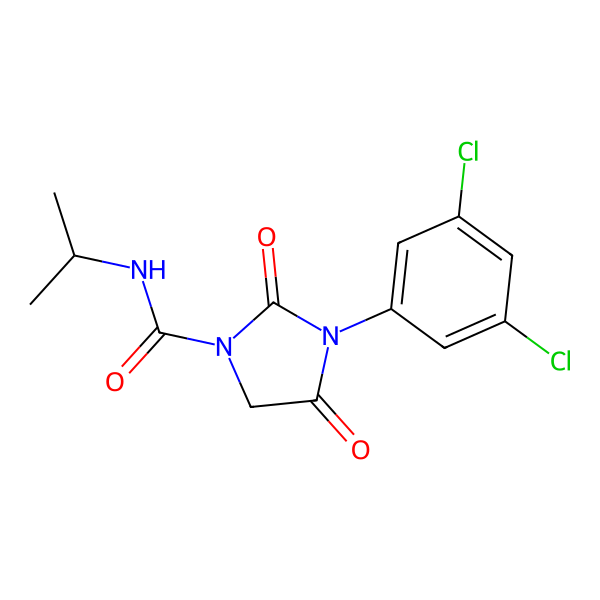
Iprodione is an imidazolidine-2,4-dione in which the nitrogen at position 1 is substituted by an N-(isopropyl)carboxamide group while that at position 3 is substituted by a 3,5-dichlorophenyl group. A contact fungicide, it blocks the growth of the fungal mycelium and inhibits the germination of fungal spores. It is used on fruit and vegetable crops affected by various fungal diseases. It is also used as a nematicide. It has a role as a nematicide and an antifungal agrochemical. It is a member of benzenes, an imidazolidine-2,4-dione, a member of ureas, an imidazole fungicide and a dichlorophenyl dicarboximide fungicide.
Source: ChEBI
| Molecular formula | C13H13Cl2N3O3 |
|---|---|
| Molecular weight | 330.16 g/mol |
| IUPAC name | 3-(3,5-dichlorophenyl)-2,4-dioxo-N-propan-2-ylimidazolidine-1-carboxamide |
| InChIKey | ONUFESLQCSAYKA-UHFFFAOYSA-N |
| SMILES | CC(C)NC(=O)N1CC(=O)N(C1=O)C2=CC(=CC(=C2)Cl)Cl |
Computed by PubChem (NCBI)
Synonyms:
IPRODIONE, Rovral, Glycophene, Glycophen, Promidione, Iprodial, Kidan, Rovral flo, Chipco 26019, Rovral PM