Ochratoxin B
cas: 4825-86-9 — see every product listed under this CAS number, including other names
Ochratoxin B (CAS 4825-86-9) is a chemical reagent available from Chemat. Available pack sizes: 1mg, 5mg, 500μg, 2mg, 10mg. Offered by: GLPBio, Biosynth, Thermo Scientific (Acros), HPC Standards.
| brand | GLPBio |
|---|---|
| catalog number | GC40870-1 |
| cas | 4825-86-9 |
| size | 1mg |
Need more information?
Ask us about this product — we're happy to help.
Available pack sizes
| brand | size | price | |
|---|---|---|---|
| GLPBio | 1mg | 1397.41 Pln | |
| GLPBio | 5mg | 3260.24 Pln | |
| GLPBio | 500μg | 929.36 Pln | |
| Biosynth | 1mg | price on request | |
| Biosynth | 2mg | price on request | |
| Thermo Scientific (Acros) | 1MG | 1327.43 Pln | |
| Biosynth | 5mg | price on request | |
| HPC Standards | 10mg | 5555.30 Pln |
properties
| purity | No data |
|---|---|
| delivery time | To be confirmed by Chemat |
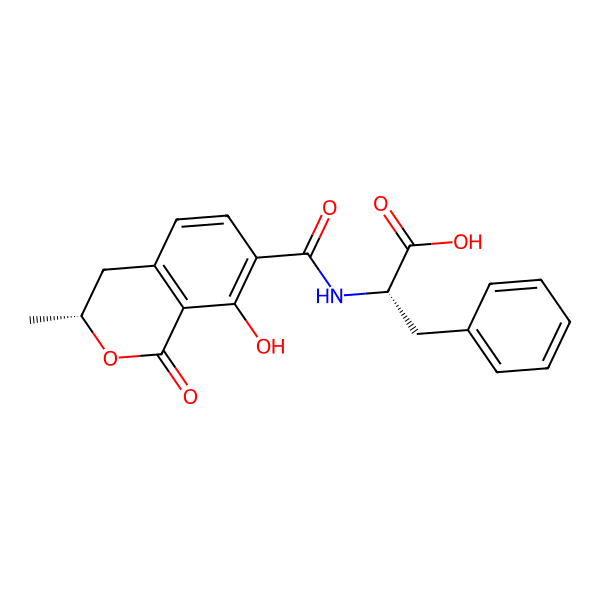
Ochratoxin B is a phenylalanine derivative resulting from the formal condensation of the amino group of L-phenylalanine with the carboxy group of (3R)-8-hydroxy-3-methyl-1-oxo-3,4-dihydro-1H-2-benzopyran-7-carboxylic acid. Ochratoxin B differs from the more naturally abundant ochratoxin A in the absence of the dihydroisocoumarin chlorine atom. It has cytotoxic effects on kidney and liver cells in vitro but only minor effects in vivo, due to its rapid metabolism and excretion. It inhibits cell proliferation of human liver HepG2 cells at doses as low as 1 g/ ml but lacks the genotoxic activity of ochratoxin A, even at higher concentrations. It has a role as a mycotoxin, a calcium channel blocker, an Aspergillus metabolite and a Penicillium metabolite. It is a monocarboxylic acid, a phenylalanine derivative, a member of isochromanes and a N-acyl-L-phenylalanine. It is a conjugate acid of an ochratoxin B(1-).
Source: ChEBI
| Molecular formula | C20H19NO6 |
|---|---|
| Molecular weight | 369.4 g/mol |
| IUPAC name | (2S)-2-[[(3R)-8-hydroxy-3-methyl-1-oxo-3,4-dihydroisochromene-7-carbonyl]amino]-3-phenylpropanoic acid |
| InChIKey | DAEYIVCTQUFNTM-ABAIWWIYSA-N |
| SMILES | C[C@@H]1CC2=C(C(=C(C=C2)C(=O)N[C@@H](CC3=CC=CC=C3)C(=O)O)O)C(=O)O1 |
Computed by PubChem (NCBI)
Synonyms:
OCHRATOXIN B, Alanine, N-((8-hydroxy-3-methyl-1-oxo-7-isochromanyl)carbonyl)-3-phenyl-, (-)-, Alanine, N-[(8-hydroxy-3-methyl-1-oxo-7-isochromanyl)carbonyl]-3-phenyl-, (-)-, Ochratoxin B(OTB), DAEYIVCTQUFNTM-ABAIWWIYSA-N, OCHRATOXIN B [MI], OCHRATOXIN B [HSDB], orb1991889, Ochratoxin B 10 |Ig/mL in Acetonitrile, Ochratoxin B 10 microg/mL in Acetonitrile